

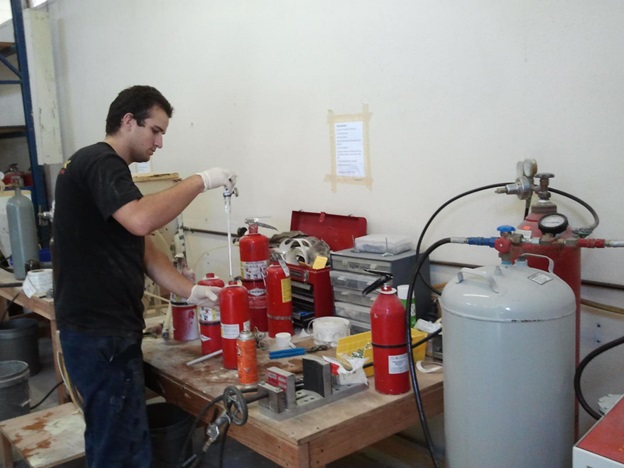
All fire extinguishers, regardless of the type of structures and the substances contained in them, need regular recharging, which can be carried out a limited number of times. Most often, non-observance of inspection time intervals and ignoring the planned charge of the cylinder become the causes of the equipment inoperative state at the right time.
The introduction of a fire extinguisher into operation is possible only if it is prepared for use, which can only be confirmed after a thorough check. The decision to send the fire extinguisher for recharging should be made by an appointed and trained employee based on the results of a regular or unscheduled diagnosis of his condition.
You can determine the timing of charging with a fire extinguishing agent according to several basic parameters:
- Its appearance;
- Degree of exploitation;
- Environmental factors
Fire extinguisher recharging intervals
Fire safety rules establish the frequency of filling devices. Per the requirements, the following rate is established:
- At least once a year for air-foamy, emulsion, water types;
- Recharge of OP-2 fire extinguishers is also carried out once a year;
- At least every five years for chronic, carbon dioxide (DU) and foam devices;
immediately after use;
- If as a result of the leakage the loss of the displacing component turned out to be higher than the permissible volume (determined by the results of the control measurement of the mass of the cylinder or by the manometer);
- Devices having a stabilized hydrocarbon blowing agent as part of OTV need refuelling every two years;
- A stainless steel cylinder with an internal coating of a unique composition containing epoxy or polymer is refilled every five years.
The procedure is carried out by organizations (stations) specializing in fire safety.
Before recharging powder fire extinguishers, check their operational parameters: appearance, pressure gauge, the integrity of sockets and hoses. After selecting several devices, they are sent to a service centre, where a specialist will open the case and examine the flowability of the powder and powder lumps.
If the lumps are destroyed when falling from a small height (about 20 cm) or when tossing them up, then the lumps are considered an acceptable norm. Also, tests are carried out for moisture content and dispersion.
Powdered fire extinguishers are permitted for vehicles. If it is installed in the cabin without the possibility of exposure to an aggressive environment, then it is checked once every two years. If located outside the vehicle, the device is exposed to adverse conditions. Therefore, the reloading of powder extinguishers is carried out every year.
Refuelling powder must be hermetically sealed; otherwise, the surrounding moisture will ruin the substance. The marking must be indicated on the refuelling material, and accompanying documentation is provided. All these conditions are checked before refuelling. Since moisture affects the characteristics of the powder most of all, when refuelling, all precautions against moisture entering the body are observed.
After recharging fire extinguisher, a mark on the work done is put on its body. It can be a label or a tag. Also, the result of refuelling is noted in the passport of each fire extinguisher.
